
Odor Treatment Methods for Agricultural Facilities
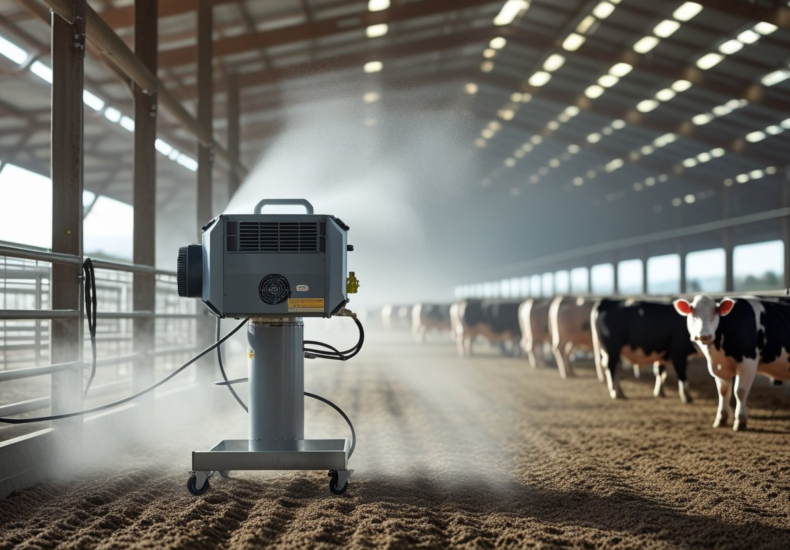
Odor emissions from agricultural operations present persistent environmental challenges, often resulting in complex regulatory, ecological, and community concerns. From vapor-phase contamination to site-specific hydrocarbon impacts, remediation within livestock zones must be both strategic and science-based. Remedia International, a technology company focused on environmental remediation, offers structured solutions that support effective environmental risk management across agricultural sites. As part of a comprehensive agricultural odor treatment strategy, Remedia™ products can be deployed as fog, mist, or floor applications inside barns, poultry houses, and livestock enclosures to address odor at its source through surface contact and atmospheric neutralization.
Environmental remediation is the strategic process of addressing pollution or contaminants present in natural or built environments. It involves the application of technologies and interventions designed to manage emissions, reduce vapors, and mitigate environmental impact in a targeted, sustainable manner. Rather than relying on a single solution, remediation operates as a holistic system—adapting to the type of pollutant, its location, and regulatory context. Companies like Remedia International implement adaptable treatment strategies that integrate into existing workflows, supporting risk reduction across odor-heavy industries such as agriculture, waste, and wastewater management.
Source Control
Remediation begins at the source—identifying and minimizing the origin of odors or contaminants. For agricultural settings, this can mean treating surfaces and equipment directly to reduce emissions from manure, bedding, or processing residues.
Containment and Stabilization
Once the source is managed, remediation focuses on preventing the spread of contaminants. In enclosed or semi-enclosed structures, this can involve limiting airborne transmission or preventing vapor-phase migration using physical and chemical boundaries.
Treatment and Mitigation
Remediation technologies such as those developed by Remedia International introduce active agents that break down or neutralize harmful compounds. Whether deployed via fogging or surface application, these treatments are designed to minimize environmental load while remaining compatible with operational needs.
An effective remediation system includes several integrated components that work together to reduce environmental risks. Application systems such as foggers, misters, or floor-spray units ensure uniform distribution of the treatment. These systems deliver treatment agents—formulated to interact with odor-causing compounds through physical contact or vapor-phase exposure. Finally, monitoring and support infrastructure helps maintain consistency, ensuring that application schedules, dosing levels, and spatial coverage align with environmental safety targets. Remedia™ is designed to work seamlessly within these system layers, supporting proactive environmental management across a range of industrial and agricultural environments.
Remedia International is a technology-based environmental remediation company specializing in odor and vapor treatment across a wide range of industrial and municipal applications. Founded in 2004 in Israel, the company has expanded its presence with operations and distribution in over 20 countries across Europe, North America, and Asia. Its work focuses on developing safe and scalable treatments for air and surface environments impacted by waste, agriculture, and chemical emissions. As part of its farm odor pollution solution portfolio, Remedia develops proprietary formulations and modular systems that integrate into existing facility infrastructure to support compliance and sustainability initiatives.
Remedia offers a range of remediation technologies designed to manage emissions from solid waste, wastewater, industrial processes, and agricultural activity. These technologies target both surface and atmospheric contaminants, including organic odors, volatile compounds, and process-related vapors. The core systems consist of proprietary treatment agents deployed through fogging units, spray bars, and floor application systems. Designed for use in open yards, enclosed spaces, and semi-confined structures, Remedia’s solutions adapt to varying operational settings without requiring structural redesign. Deployment methods include mobile misting, fixed-line delivery, and integration into ventilation systems. These systems are engineered to act on odor and vapor pathways while maintaining operational safety and compatibility with surrounding equipment.
Remedia’s modular remediation technologies are designed for flexibility across industrial and agricultural sectors. For instance, the AGRI product line is tailored for barns, stables, poultry houses, and livestock enclosures—using fogging or surface application to address airborne and contact-based odor sources. In the municipal sector, treatment systems are used in transfer stations and waste reception halls to address transient and residual emissions. Industrial deployments include ventilation-integrated vapor neutralization in chemical and production plants. Across all use cases, the technology framework is built for high-frequency or continuous deployment, supported by refillable tanks, programmable dosing, and minimal maintenance components. These applications reflect a system-based approach that emphasizes operational integration rather than isolated interventions.
Assessment and Planning
Before implementation, site-specific assessments identify emission sources, exposure zones, and operational constraints. This planning phase determines the appropriate technology type, application method, and frequency of treatment.
Deployment and Implementation
Once the site plan is established, Remedia systems are installed using fixed or mobile units such as foggers, misters, or floor spray systems. These are positioned to maximize surface and airspace coverage, with dosing calibrated based on usage volume and environmental conditions.
Monitoring and Operational Considerations
Ongoing application is maintained through refillable tanks and programmable timers, with treatment frequency adjusted as needed. Operators are trained in product handling, dosing intervals, and system inspection to ensure operational continuity and safety. Maintenance needs are minimal, supporting reliable, long-term use.
Remedia’s technologies are deployed across a diverse range of industrial and environmental settings. In manufacturing and processing facilities, odor and vapor treatment systems are installed near emission points or integrated into ventilation pathways. For hydrocarbon-impacted environments such as petroleum sites or contaminated soils, products are applied through targeted misting to minimize atmospheric dispersion. Waste management and transfer stations—often characterized by high-volume, short-term odor generation—use Remedia solutions for floor and airspace coverage in reception halls, loading bays, and transport zones. Environmental restoration projects, including those driven by regulatory mandates or compliance inspections, adopt Remedia systems to manage emissions during remediation activities. The modularity of the systems allows them to adapt to enclosed, semi-enclosed, and open-air environments across both permanent and temporary installations. Each application is tailored to site conditions and operational needs, ensuring consistency within a structured environmental management plan.
Remedia systems are designed with environmental handling and regulatory compliance in mind. All treatment agents are manufactured for safe atmospheric and surface interaction, supporting use in sensitive environments without requiring enclosure or evacuation. Application frequency and method are tailored to site-specific factors such as airflow, humidity, and contaminant concentration. Systems operate under standard ambient conditions and do not require pressurized storage or complex control panels. From a sustainability perspective, the modular design and refillable components support responsible long-term use. As part of its broader livestock odor treatment offering, Remedia technologies are suitable for agricultural environments where odor emissions intersect with worker safety, livestock welfare, and air quality compliance frameworks.
Remedia systems are designed for seamless integration into existing site infrastructure without the need for structural modifications. Application units can be deployed as mobile foggers, mounted misting systems, or floor sprayers depending on spatial layout and operational flow. Tanks are refillable and dosing controls are programmable, allowing operators to adjust schedules based on odor or vapor intensity. The systems require minimal maintenance and are suited for both temporary and permanent installations. Storage of Remedia™ agents follows standard handling guidelines, with no special pressure or temperature requirements. Training support is provided to ensure proper setup, dosing, and system upkeep in varied environments.
Frequently Asked Questions (FAQs)
What is environmental remediation?
Environmental remediation is the process of managing pollutants, vapors, or odors in industrial, agricultural, or municipal settings through technology-based interventions that reduce environmental exposure risks.
Where can remediation systems be applied?
Remediation systems are used in locations such as waste processing facilities, agricultural buildings, industrial plants, and hydrocarbon-impacted sites—anywhere emissions or environmental stressors require structured mitigation.
Are remediation treatments safe to handle?
Remedia™ products are formulated for safe handling in operational settings. Application does not require evacuation or sealing of treated areas, and agents are deployed through low-pressure, ambient systems.
What infrastructure is required for installation?
Basic requirements include power sources for dosing equipment and spatial access for placing fogging or spray units. No structural changes or specialized enclosures are needed.
How do remediation systems differ from traditional methods?
Traditional methods often rely on masking agents or physical barriers. In contrast, remediation systems use direct application to surface and air pathways, integrating with site routines for consistent treatment.
Do these systems impact the environment?
The systems are designed with environmental compatibility in mind. Treatments do not leave harmful residues, and refillable tanks reduce material waste over time.
As global regulations evolve and environmental accountability becomes integral to operational planning, technologies that support structured remediation are increasingly part of routine facility management. Companies operating in agriculture, waste processing, and industrial production must now consider emissions as part of their compliance, safety, and community interface responsibilities. Remedia International provides adaptable, modular solutions that address these needs through process-oriented application systems and surface-to-air treatment agents. By aligning remediation strategies with real-world infrastructure, the company supports practical environmental stewardship across diverse operational landscapes. With presence in more than 20 countries and technologies active in municipal, agricultural, and industrial settings, Remedia continues to work in collaboration with site managers, regulators, and engineers to address emission control as part of long-term environmental planning.