
Workers Compensation Prescription Drug Management: Controlling the Fastest-Growing Cost Driver
Workers compensation prescription drug management has become one of the most consequential areas of claims cost control as pharmaceutical spending in workers’ compensation has grown to represent a significant and often poorly monitored portion of total claim costs. Unlike medical treatment costs that go through utilization review and often require prior authorization, prescription drug costs in many claims programs have historically been less systematically reviewed — which has allowed pharmacy spend to grow in ways that don’t always reflect genuine clinical necessity and that add cost to claims without proportionate benefit to injured workers’ recovery.
Why Pharmacy Costs Have Grown So Rapidly
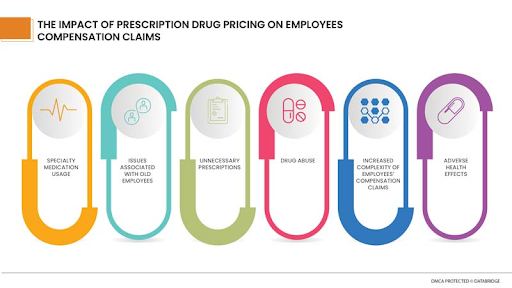
Several factors have combined to make workers compensation prescription drug management an increasingly important focus for carriers, TPAs, and self-insured employers. The availability and aggressive marketing of expensive brand-name medications in categories where lower-cost generic alternatives exist and perform equivalently. The prescribing of opioid medications for workplace injuries at rates that reflect prescribing patterns developed before the full dimensions of opioid dependency risk were broadly understood by the medical community. Compound medications — custom-formulated topical preparations that bypass standard formulary controls and are frequently priced at multiples of what standard medications cost — have driven significant pharmacy spend increases in claims where prescribers have access to compounding pharmacy relationships.
Each of these patterns represents pharmacy spend that clinical oversight can identify and address — but only if there’s a systematic review process in place rather than automatic reimbursement of whatever gets prescribed.
What Clinical Pharmacy Review Actually Does
A workers compensation consultant with pharmacy benefit management expertise applies clinical analysis to the prescription drug component of a claim in ways that standard bill review doesn’t provide. Where standard bill review confirms that charges are billed correctly and reimbursed at the right fee schedule rate, clinical pharmacy review evaluates whether the medications being prescribed are clinically appropriate for the diagnosis, whether lower-cost alternatives with equivalent clinical outcomes exist, and whether the duration of prescription use is consistent with the expected recovery timeline for the injury.
This is particularly consequential for opioid prescribing, where workers compensation claims represent a context in which clinical oversight of prescription duration and dose is both clinically important for the injured worker’s long-term wellbeing and financially important for the claim’s cost trajectory. A claim where opioid prescribing continues well past the acute injury phase without clinical justification for ongoing use is a claim where clinical intervention can produce better outcomes for the injured worker and lower costs for the payer simultaneously.
Compound Medications and How They Inflate Claim Costs
Compound medications represent one of the most significant pharmacy cost challenges in workers compensation prescription drug management. These custom-formulated preparations — typically topical pain creams or gels — are not subject to the same formulary controls as standard medications, are frequently prescribed at costs of hundreds or even thousands of dollars per tube, and in many cases don’t have clinical evidence supporting their effectiveness that would justify those costs relative to standard alternatives.
A peer review of a claim with significant compound medication spend evaluates whether the compound formulation is medically necessary given what standard medications could achieve, whether the prescribing pattern is consistent with evidence-based treatment guidelines, and whether the cost is proportionate to the clinical benefit being claimed. In many cases, clinical review supports transition to standard medications at a fraction of the cost without clinical compromise — which produces immediate and substantial claim cost reduction.
Formulary Management as a Proactive Strategy
Rather than addressing pharmacy costs reactively after they’ve accumulated in individual claims, proactive workers compensation prescription drug management uses formulary controls to establish upfront which medications are approved for workers’ compensation claims in a specific program and which require prior authorization before reimbursement.
Evidence-based formularies that reflect current clinical guidelines for treating the most common workers’ compensation injury categories — musculoskeletal injuries, back and neck conditions, occupational illness — create a framework that channels prescribing toward clinically appropriate, cost-effective medications while flagging outlier prescribing for clinical review before costs are incurred rather than after the fact.
Data Analytics and Predictive Identification of At-Risk Claims
Modern workers compensation prescription drug management increasingly relies on data analytics to identify claims trending toward problematic pharmacy patterns before those patterns become entrenched. Predictive modeling that draws on prescribing history, injury classification, comorbidities, and early treatment trajectories can flag claims at elevated risk for prolonged opioid use, escalating dose requirements, or transition to compound medications weeks or months before those developments would typically be caught in retrospective review. Claims flagged through predictive analytics can be routed to clinical pharmacy review at the point where intervention is most effective — early enough to redirect the treatment trajectory without disrupting an established prescribing relationship. This shift from reactive to predictive management has emerged as one of the most significant developments in pharmacy cost control, allowing programs to allocate scarce clinical review resources to the claims where that review will produce the greatest impact on both cost and clinical outcomes.
Physician Engagement and Collaborative Prescribing Decisions
Clinical pharmacy management works best when structured as collaboration with treating physicians rather than as reimbursement denial after prescribing has occurred. Peer-to-peer outreach — where a clinical pharmacist or physician advisor discusses a specific patient’s medication regimen directly with the prescribing physician — produces significantly better prescribing modifications than administrative denials that leave the physician to work out alternatives on their own. Effective programs invest in these physician relationships and provide prescribers with evidence-based alternatives, tapering protocols, and clinical decision support that makes appropriate prescribing easier rather than simply penalizing inappropriate prescribing after the fact. The result is a working relationship in which the treating physician sees the pharmacy management program as a clinical resource rather than an administrative adversary.
Measuring the Return on Clinical Pharmacy Investment
Programs that implement systematic workers compensation prescription drug management should track outcomes across both cost and clinical dimensions to validate the investment. Cost metrics include per-claim pharmacy spend, generic dispensing rates, compound medication reduction, and morphine equivalent dose trends across the book of business. Clinical metrics include return-to-work timelines, functional recovery measures, and the rate at which claims transition into long-term opioid dependency. Programs that measure both dimensions consistently demonstrate that clinical pharmacy management is not simply a cost-cutting exercise but a genuine improvement in claim quality — better outcomes for injured workers alongside more sustainable costs for payers, aligning the interests of every stakeholder in the workers compensation system.
Duration of Prescribing and Long-Term Claim Cost
One of the most consistent findings in workers compensation prescription drug management analysis is the relationship between prescription duration and overall claim cost. Claims where medication prescribing — particularly opioid prescribing — extends significantly beyond the expected acute recovery period for the injury are claims with consistently higher total costs and longer duration than similar injury claims where prescribing is more consistent with recovery timelines.
Clinical review that flags prescription duration as an issue and supports treating physicians in developing appropriate tapering plans where medically warranted serves both the injured worker’s long-term interests and the claim’s cost trajectory. That dual benefit is what makes clinical pharmacy management one of the highest-return interventions available in complex workers’ compensation claims.