
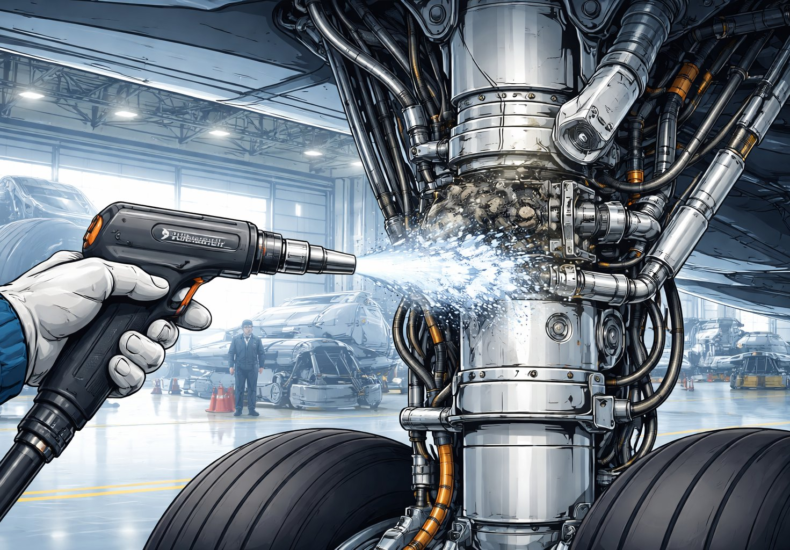
Aircraft Landing Gear Maintenance: Safe Hydraulic Fluid Removal
Maintaining aerospace components presents significant industrial cleaning challenges, particularly regarding the buildup of heavy hydraulic fluid, grease, and carbon on sensitive surfaces. Traditional cleaning methods often result in excessive downtime or risk damaging delicate parts through abrasion or chemical exposure. Nu-Ice Blasting™ addresses these concerns as a leading industrial dry ice blasting equipment manufacturer, offering a superior alternative to abrasive, wet, or chemical cleaning processes. Utilizing dry ice blasting aviation technology, the Nu-Ice Blasting™ system provides a non-abrasive solution that thoroughly cleans landing gear without compromising underlying metals, intricate wiring, or sensors. This precise cleaning method serves as a crucial preparation step for non-destructive testing (NDT) and crack inspections, ensuring safety and operational integrity in aviation maintenance.
Dry ice blasting is an industrial cleaning process that utilizes solid carbon dioxide (CO2) pellets as a cleaning medium. The process involves accelerating these rice-sized pellets through a pressurized air stream to strike a surface at high velocities. Upon impact, the dry ice pellets transition directly from a solid to a gas in a process known as sublimation. Because the cleaning media disappears into the atmosphere, the process creates no secondary waste, such as contaminated water or abrasive grit. This unique characteristic allows Nu-Ice Blasting™ equipment to remove contaminants without leaving behind additional residue, making it an efficient solution for sensitive environments where traditional cleaning byproduct disposal is problematic.
Kinetic Impact
Dry ice pellets are propelled by compressed air at high speeds. When they strike the surface, the kinetic energy loosens the bond between the contaminant and the substrate.
Thermal Shock
The extreme cold of the dry ice pellets (-109°F) causes the contaminant to freeze rapidly. This temperature differential makes the residue brittle and weakens its adhesion to the underlying material.
Sublimation Expansion
As the pellets sublimate upon impact, they expand in volume by nearly 800 times. This rapid gas expansion creates a “micro-explosion” effect that lifts the fractured contaminant off the surface.
A standard Nu-Ice Blasting™ system consists of several essential components designed to deliver a consistent cleaning stream. The process begins with an air compressor, which provides the necessary volume and pressure of air. Within the machine, the dry ice hopper stores the CO2 pellets before they enter the metering system. The metering system ensures a precise amount of ice is fed into the air stream to maintain efficiency. Finally, the mixture travels through a specialized hose and nozzle assembly. The nozzle is engineered to accelerate the pellets to the required velocity, allowing the operator to direct the cleaning power toward specific targets like landing gear assemblies.
Founded in 2011, Nu-Ice Blasting™ is a dedicated manufacturer of industrial dry ice blasting equipment based in the United States. All machines are “Made in the USA,” reflecting the company’s commitment to high-quality manufacturing and engineering standards. The company focuses on producing durable, high-performance equipment that facilitates aircraft landing gear cleaning and other demanding industrial applications. Nu-Ice Blasting™ provides a range of pneumatic and electric-powered models designed to meet various pressure requirements and cleaning intensities. By focusing on the production of reliable hardware, the company enables maintenance professionals to implement dry ice technology as a standard protocol for removing tough residues like hydraulic fluid and carbon buildup while ensuring the longevity of the machinery being serviced.
Nu-Ice Blasting™ equipment incorporates several functional features designed for industrial durability and precision. The blasting gun is engineered for ergonomic use and compatible with a variety of interchangeable nozzle options, allowing operators to adjust the blast pattern based on the specific geometry of the aerospace component. To ensure the integrity of the cleaning media, many units include an integrated moisture separator. This component removes condensation from the compressed air supply, preventing the dry ice pellets from clumping or clogging the internal delivery system. Additionally, an aftercooler may be utilized to regulate the temperature of the incoming air. These features work in tandem to maintain a consistent flow of dry ice, ensuring that the mechanical components of the blaster operate reliably during extended maintenance cycles without interruption from environmental moisture or temperature fluctuations.
The technical specifications of Nu-Ice Blasting™ machines vary across their product line to accommodate different industrial requirements. For example, the IB Professional series typically features a hopper capacity of approximately 50 to 100 pounds of dry ice. These units are designed with mobility in mind, often weighing between 150 and 210 pounds depending on the specific model and integrated accessories. Dimensionally, the machines are constructed to be compact enough for hangar environments, generally measuring around 20 inches in width and 36 inches in height. Operationally, the equipment requires a significant air flow range, typically between 50 and 250 CFM, with a working pressure range that can be adjusted from 50 to 125 PSI. Dry ice consumption rates are variable based on the application, ranging from 0.5 to 3.5 pounds per minute, allowing for precise control over the cleaning intensity.
The operational sequence for using Nu-Ice Blasting™ equipment begins with preparation and setup, which involves connecting the unit to a high-volume air compressor and ensuring all hoses are securely coupled. Safety requirements are a primary consideration; operators must wear appropriate personal protective equipment (PPE), including thermal gloves, eye protection, and hearing protection due to the decibel levels produced by high-velocity air. The typical workflow steps involve filling the insulated hopper with dry ice pellets and adjusting the blast pressure and ice feed rate on the control panel. Once the system is pressurized, the operator directs the nozzle toward the targeted area, such as landing gear struts or wheel wells. After the cleaning task is complete, the workflow concludes with a system purge to clear any remaining ice from the lines and a formal shutdown of the compressed air source.
Nu-Ice Blasting™ equipment is utilized across a broad spectrum of sectors due to its non-conductive and non-abrasive nature. In manufacturing and production, the machines are used for cleaning molds, core boxes, and assembly line equipment. The food processing and sanitation industry employs this technology to remove proteins, fats, and seasonings from conveyor systems and ovens without the use of water or chemicals. For historical restoration and delicate surfaces, the equipment is applied to remove soot, smoke damage, or lead paint from sensitive substrates like masonry or wood. In the automotive and electrical sectors, it is used for engine degreasing and cleaning energized electrical components, such as switchgear and transformers. Within the aerospace industry, the equipment is specifically deployed for cleaning airframes and landing gear assemblies, where removing hydraulic fluids and carbon buildup from complex configurations is a standard maintenance requirement.
The primary advantage of utilizing Nu-Ice Blasting™ equipment is the elimination of secondary waste, as the dry ice media sublimates upon impact. This characteristic is essential for aerospace dry ice cleaning, where traditional grit or water-based runoff could damage sensitive components. The process is entirely non-abrasive, ensuring that surface integrity is maintained without etching or profiling the underlying metal. Because it is a dry, chemical-free process, there is no risk of moisture-related corrosion or chemical residue. Operational considerations include ensuring proper ventilation to manage CO2 levels and following specific handling protocols for the extremely cold dry ice pellets. These factors allow for a streamlined cleaning workflow that is both environmentally responsible and surface-safe for high-precision industrial parts.
To maximize the utility of Nu-Ice Blasting™ systems, various accessories are available for specific integration needs. A wide range of nozzles, including flared, round, and specialized extension options, allow the operator to reach tight geometries within industrial machinery. High-pressure hoses are provided in various lengths to facilitate mobility around large equipment. Integration with an external air supply is necessary, and the use of aftercoolers is recommended to ensure the compressed air is dry and cool, preventing ice clumping. For long-term performance, storage of the dry ice pellets in insulated containers and routine maintenance of the machine’s seals and filters are required.
- Advantages and Operational Considerations
The primary advantage of utilizing Nu-Ice Blasting™ equipment is the elimination of secondary waste, as the dry ice media sublimates upon impact. This characteristic is essential for aerospace dry ice cleaning, where traditional grit or water-based runoff could damage sensitive components. The process is entirely non-abrasive, ensuring that surface integrity is maintained without etching or profiling the underlying metal. Because it is a dry, chemical-free process, there is no risk of moisture-related corrosion or chemical residue. Operational considerations include ensuring proper ventilation to manage CO2 levels and following specific handling protocols for the extremely cold dry ice pellets. These factors allow for a streamlined cleaning workflow that is both environmentally responsible and surface-safe for high-precision industrial parts.
- Accessories and System Integration
To maximize the utility of Nu-Ice Blasting™ systems, various accessories are available for specific integration needs. A wide range of nozzles, including flared, round, and specialized extension options, allow the operator to reach tight geometries within industrial machinery. High-pressure hoses are provided in various lengths to facilitate mobility around large equipment. Integration with an external air supply is necessary, and the use of aftercoolers is recommended to ensure the compressed air is dry and cool, preventing ice clumping. For long-term performance, storage of the dry ice pellets in insulated containers and routine maintenance of the machine’s seals and filters are required.
Frequently Asked Questions (FAQs)
What exactly is dry ice blasting?
Dry ice blasting is an industrial cleaning method that uses solid CO2 pellets accelerated by compressed air. The pellets sublimate on impact, removing surface contaminants through a combination of kinetic force, thermal shock, and rapid gas expansion without leaving secondary residue.
Is Nu-Ice Blasting™ equipment compatible with standard air compressors?
Yes, the equipment is designed to integrate with standard industrial air compressors. However, the compressor must meet specific CFM (cubic feet per minute) and PSI requirements—typically between 50 and 250 CFM—to ensure the blasting stream remains consistent and effective.
What are the primary safety considerations during operation?
Operators must use personal protective equipment, including insulated gloves to handle dry ice at -109°F, eye protection, and hearing protection. Additionally, because the process involves CO2, operation in well-ventilated areas is necessary to prevent the displacement of oxygen.
What infrastructure is required to use these machines?
The basic infrastructure includes a reliable source of high-volume compressed air and a steady supply of high-density dry ice pellets. Depending on the model, a standard electrical outlet (110V) may also be required to power the internal metering system.
How does this compare to abrasive methods like sandblasting?
Unlike sandblasting, dry ice blasting is non-abrasive and does not wear down the substrate. While abrasive methods create a large volume of waste media that must be collected and disposed of, dry ice sublimates, leaving only the removed contaminant for cleanup.
What is the environmental impact of using dry ice?
Dry ice blasting is environmentally friendly because it uses reclaimed CO2 that is a byproduct of other industrial processes. It eliminates the need for harsh chemical solvents and prevents the creation of contaminated wastewater, significantly reducing the overall environmental footprint.
Can Nu-Ice Blasting™ equipment be used on electrical components?
Yes, since dry ice is non-conductive and the process is entirely dry, it can be used to clean electrical motors, switchgear, and other energized components. This allows for cleaning without the risk of short circuits or the need for extensive drying time.
As the aviation industry continuously seeks to optimize maintenance protocols and enhance safety standards, the implementation of precise, non-destructive cleaning technologies remains paramount. Nu-Ice Blasting™, as a dedicated US-based manufacturer of industrial dry ice blasting equipment since 2011, provides the robust hardware necessary to implement these advanced cleaning standards. The company’s focus on engineering reliable, high-performance pneumatic and electric-powered blasting systems ensures that maintenance professionals have access to technology capable of addressing complex contamination challenges without compromising the integrity of critical aerospace infrastructure or sensitive electronic components. By offering a range of durable machines and functional accessories, Nu-Ice Blasting™ supports the operational efficiency of MRO facilities dedicated to maintaining the highest levels of safety and performance in the aerospace sector.